Is Cold Email Spam? A 2026 Data-Driven Analysis
Cold email is legal under the CAN-SPAM Act if specific rules are followed. This guide analyzes how data quality and legal compliance separate outreach from.

Cold email is not inherently spam if it complies with the CAN-SPAM Act's requirements for transparency and opt-out mechanisms. According to the Act, commercial emails must include a valid physical postal address, a clear unsubscribe link, and non-deceptive subject lines. [1, 8] The key distinction lies in data quality and relevance; outreach using verified, targeted contact data for a legitimate business purpose is legally permissible, whereas high-volume, untargeted sends risk both legal penalties and technical blacklisting by email providers. [2, 11]
TL;DR
- The CAN-SPAM Act permits B2B cold email, requiring an unsubscribe link and physical address, with fines up to $51,744 per email for violations. [1]
- Data vendors like Apollo and ZoomInfo have strong US enterprise coverage but lower resolution for local businesses and international contacts. [33, 40]
- B2B contact data decays at a rate of 22.5% to 30% annually, making continuous data verification essential to avoid high bounce rates. [3, 9]
- Google and Yahoo require all senders to use SPF and DKIM, and bulk senders (5,000+ emails/day) must also use DMARC and keep spam complaints below 0.3%. [4, 12]
- Focusing on plain-fact leads with verified contact data is more effective than using tools that generate unsubstantiated AI fit scores and narratives.
Legal vs. Perceptual Spam: The CAN-SPAM Act in 2026
The CAN-SPAM Act of 2003 establishes the legal framework for commercial email in the United States, making B2B cold email permissible so long as senders adhere to its specific rules. [8] Unlike perceptual spam, which is defined by the recipient's subjective experience, legal spam is a matter of compliance with seven core requirements defined by the Federal Trade Commission (FTC). Every commercial email must feature non-deceptive header information, use subject lines that accurately reflect the message's content, and identify the message as an advertisement. [6] A recent analysis from Sopro's 2025 email marketing report found that while open rates have nearly doubled since 2016 (from 18.7% to 35.9%), the average time a recipient spends reading an email is now less than nine seconds, underscoring the importance of clear, upfront communication to avoid being perceived as spam, even when legally compliant. [26] The law explicitly applies to B2B communications; if the primary purpose of the message is commercial, it must follow the Act's guidelines, a point often misunderstood by sales and marketing teams who incorrectly assume an exemption for business-to-business outreach. [8, 20]
Penalties for non-compliance with the CAN-SPAM Act are severe and calculated on a per-email basis, creating significant financial risk for companies engaging in high-volume outreach. As of the FTC's January 2025 inflation adjustment, the maximum civil penalty is $53,088 for each separate email that violates the law. [2, 3] This means a single non-compliant campaign sent to a list of just 1,000 contacts could theoretically result in over $53 million in fines. Both the company whose products are being promoted and the third-party agency or individual who sends the messages can be held legally responsible. [20] While the theoretical maximums are rarely imposed, the per-email structure gives regulators immense leverage in settlement negotiations. For example, in August 2024, the FTC levied its largest-ever CAN-SPAM penalty, a $2.95 million fine against security company Verkada, for sending marketing emails without a functional unsubscribe mechanism. [20] This enforcement action, along with a $650,00c case against Experian, signals that the FTC is actively pursuing violations, moving the risk from a theoretical legal concept to a tangible business liability. [2]
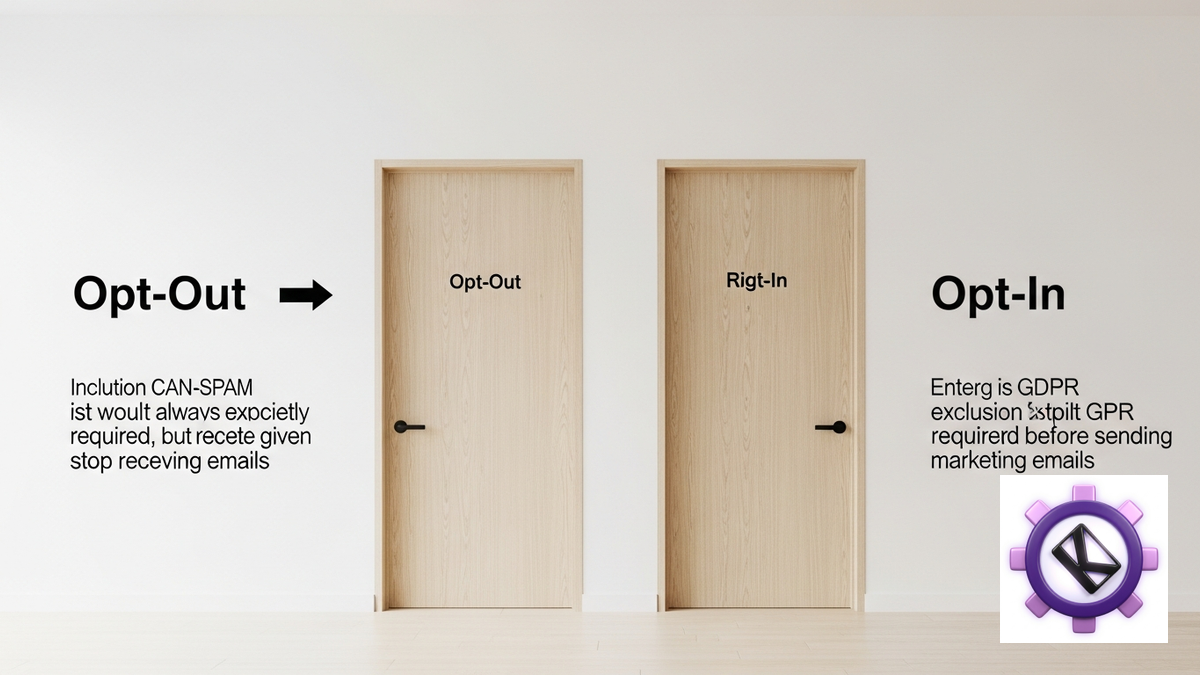
A key distinction of the CAN-SPAM Act is its 'opt-out' framework, which contrasts sharply with the 'opt-in' consent models required by regulations like the European Union's General Data Protection Regulation (GDPR) and Canada's Anti-Spam Legislation (CASL). [1, 14] Under CAN-SPAM, businesses can legally send unsolicited commercial emails provided they include a clear and functional mechanism for recipients to unsubscribe, which must be honored within 10 business days. [8] GDPR, conversely, generally requires businesses to obtain explicit, affirmative consent from individuals before sending them marketing communications, a much higher legal bar. [13, 18] This fundamental difference is critical for global businesses; a campaign that is fully compliant in the United States could be illegal in the EU. According to the Salesforce 6th Edition "State of Sales" report (n > 5,500 sales professionals), sellers are increasingly using AI to draft emails, with expectations it can reduce drafting time by 36%, a productivity gain that magnifies the compliance risk if these automated systems are not configured for jurisdictional differences in consent law. [21, 23] The UK's GDPR maintains this strict opt-in standard, with potential fines of up to £17.5 million or 4% of global turnover for violations. [11]
The core requirements for CAN-SPAM compliance center on transparency and recipient control, directly shaping the technical and operational practices of email marketers. Every email must contain a valid physical postal address of the sender and a conspicuous, operational unsubscribe link that remains functional for at least 30 days after the message is sent. [5, 19] The process to opt-out cannot be burdensome; it cannot require a fee, ask for any personal information beyond an email address, or force the user to visit more than a single web page. [8] These requirements from the CAN-SPAM Compliance Act Guide are not merely legal checkboxes; they are critical signals for email providers like Google and Microsoft. According to a 2025 B2B deliverability report, only 7.6% of domains enforce DMARC authentication, but those with full authentication are 2.7 times more likely to reach the inbox. [27] A broken unsubscribe link or missing physical address not only risks an FTC fine but also damages the sender's reputation, leading to lower inbox placement rates, which fell by over 26 percentage points for some providers in 2025. [27]
| Regulation | Geographic Scope | Consent Model | Key Requirement | Maximum Penalty |
|---|---|---|---|---|
| CAN-SPAM Act (US) | United States | Opt-Out | Must provide a clear unsubscribe mechanism and include a physical postal address. [8] | Up to $53,088 per email. [2, 6] |
| GDPR (EU) | European Union | Opt-In (Explicit) | Requires a documented, lawful basis (often explicit consent) for processing personal data before sending emails. [1, 13] | Up to €20 million or 4% of annual global turnover, whichever is higher. [1, 10] |
| CASL (Canada) | Canada | Opt-In (Express or Implied) | Requires express or implied consent before sending a Commercial Electronic Message (CEM). [1, 15] | Up to CAD $10 million for corporations. [1, 3] |
| UK GDPR | United Kingdom | Opt-In (Explicit) | Requires explicit, affirmative consent for marketing emails to individual subscribers. [4, 11] | Up to £17.5 million or 4% of annual global turnover. [11] |
| Spam Act 2003 (Australia) | Australia | Opt-In (Express or Inferred) | Must have prior consent (express or inferred) and process unsubscribe requests within 5 business days. [12, 17] | Up to AUD $1.1 million per day for repeat corporate offenders. [9] |
How Mailbox Providers Technologically Define Spam
Mailbox providers have established strict technical prerequisites for email authentication, which now serve as a primary gatekeeper for inbox placement. As of 2026, Google and Yahoo mandate that all senders authenticate their domains using both Sender Policy Framework (SPF) and DomainKeys Identified Mail (DKIM). [1, 5] For bulk senders, defined as those transmitting over 5,000 emails per day, the requirements are even more stringent, compelling the implementation of a Domain-based Message Authentication, Reporting, and Conformance (DMARC) policy. [2, 6] These protocols work in concert: SPF specifies authorized sending IP addresses, DKIM adds a digital signature to verify content integrity, and DMARC instructs receiving servers on how to handle failures. [6] The enforcement of these rules, which began ramping up through 2024 and 2025, is now absolute; non-compliant mail from bulk senders is no longer just filtered to junk but faces permanent SMTP-level rejections. [3, 5] According to Mimecast's 2026 DMARC update, this shift means that failing to meet these standards directly impacts everything from marketing campaign deliverability to the reliability of transactional emails. [6]
A sender's reputation, a comprehensive score reflecting the trustworthiness of an IP address and its associated domain, is a critical factor in deliverability. [9] Mailbox providers calculate this score by analyzing a long history of sending behavior, prioritizing domain reputation as it is more difficult to manipulate than IP reputation. [9, 24] Key negative signals that damage this score include high bounce rates from poor list hygiene, frequent spam complaints from recipients, and sending emails to known spam traps, which are addresses used specifically to identify spammers. [16] Conversely, positive recipient engagement, such as opens and replies, can bolster a sender's reputation. According to a July 2025 analysis from Twilio, while an IP reputation can be rebuilt in a few weeks with good behavior, a damaged domain reputation follows a brand across different email service providers and can lead to long-term deliverability issues. [24] Tools like Google Postmaster Tools offer senders direct visibility into their reputation, tracking metrics like user-reported spam rates and authentication compliance to help them stay within acceptable thresholds. [15, 16]
Inbox providers increasingly rely on sophisticated machine learning models to analyze hundreds of signals and assign a real-time spam score to every incoming message. These AI-driven systems have moved far beyond simple keyword matching, which spammers learned to evade. [26] Instead, modern filters, like those powered by Google's TensorFlow, employ deep learning and natural language processing (NLP) to assess a vast array of features, including email content, formatting, link patterns, header information, and, crucially, recipient engagement. [20, 29] For instance, the Salesforce "Seventh Edition State of Sales" report, which surveyed 4,050 sales professionals in late 2025, highlights that AI agents are transforming every stage of the sales cycle, a trend that relies on clean data and positive engagement signals to succeed. [28] These models are adaptive, learning continuously from new spam tactics and user feedback, making them highly effective at identifying malicious content while minimizing false positives that might block legitimate business communication. [27, 26]
To avoid being automatically routed to junk folders, bulk senders must adhere to precise performance benchmarks, most notably maintaining a spam complaint rate below 0.3%. [2, 10] Both Google and Yahoo strictly enforce this ceiling, and consistent rates above 0.1% can already lead to degraded deliverability. [3, 8] To help senders manage this, the 2024 requirements also mandated a one-click unsubscribe mechanism, which must be included in the email's header (List-Unsubscribe) per RFC 8058. [4] This feature, which must be honored within two days, is designed to give recipients an easy exit path that doesn't involve hitting the spam button, thereby protecting the sender's reputation. [12] As explained in a ZoomInfo analysis on cold email, providing a clear and easy opt-out is a foundational element of legitimate outreach that distinguishes it from spam. [21] Failure to implement a compliant one-click unsubscribe process or exceeding the complaint threshold now results in punitive actions, including throttling and outright rejection of mail. [4, 5]

Data Sourcing Determines Deliverability and Spam Risk
The foundation of any legitimate cold email campaign is accurate data, yet B2B contact information decays at a startling rate, rendering most databases obsolete faster than teams realize. Industry benchmarks show that B2B data degrades by an average of 22.5% per year, a figure primarily driven by job changes, company acquisitions, and technology migrations. [3, 8] Some analyses, such as a 2025 study by ZeroBounce which reviewed over 11 billion emails, place the annual decay rate for email validity specifically at 23%. [3] In high-turnover sectors like technology, this decay can be even more severe, with some estimates reaching as high as 70.3% annually for any-field data drift. [3, 5, 9] This continuous degradation means that without a systematic process for hygiene and enrichment, a significant portion of a sales team's outreach is directed at invalid contacts. This not only wastes resources but, as detailed in a ZoomInfo analysis on cold email, directly undermines the sender's reputation and long-term deliverability, pushing them closer to being classified as spam.
Using unverified or decayed data directly increases the risk of high bounce rates, a critical red flag for mailbox providers like Gmail and Outlook that can severely damage sender reputation. When an email campaign produces a high number of hard bounces, which are permanent delivery failures from invalid addresses, it signals to Internet Service Providers (ISPs) that the sender is engaging in poor list management. [1, 11] Industry standards consider a bounce rate under 2% to be healthy, while rates exceeding 5% can trigger penalties, including email throttling, automatic filtering into spam folders, or even blacklisting of the sending domain. [6, 15] This creates a negative feedback loop; as sender reputation declines, deliverability worsens, leading to even higher bounce rates and lower engagement, further eroding trust with ISPs. [1, 6] This technical consequence is not isolated to a single provider, as ISPs share reputation data, meaning deliverability problems with one can quickly cascade across all major platforms. [1] Consequently, maintaining a clean, verified list is not just a best practice but a technical necessity for avoiding spam filters and ensuring messages reach their intended recipients.
Major data brokers serve as the default source for many B2B sales teams, but their coverage has significant and often overlooked gaps, particularly outside of the US enterprise market. Providers like ZoomInfo and Apollo.io offer extensive databases, with ZoomInfo claiming over 150 million verified contacts and Apollo over 265 million. [29] However, their primary strength lies in North American enterprise and mid-market accounts. [24, 29] User reports and market analyses indicate that data accuracy and coverage diminish significantly for international markets (EMEA, APAC) and for smaller, local businesses. [24, 25] To counter these gaps, some teams turn to intent data providers like Bombora, whose Company Surge® product identifies accounts actively researching specific topics from a cooperative of over 5,000 publisher websites. [32, 36] While this provides a layer of behavioral relevance, it only offers company-level signals, not individual contact data, and typically updates on a weekly cadence, which can be a step behind real-time buying behavior. [20, 32] This landscape forces sophisticated teams to adopt a multi-source or waterfall enrichment strategy, which queries multiple vendors to fill data gaps and improve accuracy. [40, 45]
The cumulative effect of poor data quality translates into substantial financial losses, far exceeding the cost of data acquisition itself. Research from Gartner consistently estimates the average annual cost of bad data for an organization to be around $12.9 million, a figure that captures wasted effort, operational inefficiencies, and missed revenue. [4, 7, 17] Other analyses from sources like MIT Sloan Management Review suggest that companies lose between 15% and 25% of their annual revenue directly due to poor data quality. [14] These costs manifest in several ways: sales representatives waste up to 27% of their time dealing with incorrect contact information, marketing campaigns fail to reach their target audience, and flawed analytics lead to poor strategic decisions. [39, 43] According to Validity's 2025 State of CRM Data Management report, which surveyed 602 CRM users, unreliable data leads to an average of 16 lost sales opportunities per quarter for the typical company. [17] This demonstrates that investing in data quality is not an operational expense but a direct investment in revenue generation and risk mitigation.
| Data Sourcing Method | Typical Cost Model | Data Freshness | Spam / Bounce Risk | Best For |
|---|---|---|---|---|
| List Purchase (Brokers) | Per-record or large flat fee | Low (decays from moment of purchase) | High | Quickly building a large, cold prospect list. |
| Data Enrichment Platforms (e.g., ZoomInfo, Apollo) | Seat-based subscription ($10k-$50k+/yr) | Medium (refreshed periodically, e.g., every 90 days) | Medium | Enterprise and mid-market teams needing integrated prospecting and intelligence. |
| Waterfall Enrichment (e.g., Clay, Unify) | Credit-based or tiered subscription | High (queries multiple sources in real-time) | Low | RevOps teams wanting maximum coverage and accuracy by combining providers. [22, 45] |
| Intent Data Providers (e.g., Bombora) | Platform subscription (~$30k+/yr) | Medium (often weekly updates) | Low (when combined with other data) | ABM teams prioritizing accounts showing active buying signals. [32, 35] |
| In-House Manual Research | Labor cost (time-intensive) | High (verified at time of use) | Very Low | Targeting a small number of high-value strategic accounts. |
| Public Record Scraping | Development and maintenance cost | Variable (depends on source and process) | Very High | Niche data collection where commercial databases have poor coverage. |
Why Local Business Outreach Has a Higher Spam Complaint Rate
Major B2B databases exhibit a significant data resolution gap when targeting local businesses, a factor that directly elevates spam complaint rates. Industry analysis reveals that while large enterprise data is a core strength for major vendors, their accuracy plummets for smaller, local entities like salons, restaurants, or trade services. Research from early 2026 indicates that most B2B data providers average only 50% accuracy, with nearly a third of email addresses decaying annually. [14] This data deficiency forces outreach teams to rely on generic, role-based inboxes such as 'info@' or 'contact@', which are ineffective for personalized communication. The core issue is a mismatch of data collection models; enterprise data is often sourced from corporate filings and software integrations, whereas local business data is fragmented across public directories and municipal records. Sending to these generic addresses, which act as a catch-all for unsolicited messages, immediately lowers the perceived relevance of the outreach and increases the likelihood of it being flagged as spam, a problem that harms sender reputation even if the campaign is compliant with the CAN-SPAM Act. [1, 5] The consequences are clear: spam complaint rates above the industry threshold of 0.1% risk deliverability penalties from providers like Gmail and Outlook. [17, 21]
Sending cold emails to generic inboxes or the wrong contact person within a small business is a primary driver of high spam complaint rates, as the message's relevance is immediately compromised. When an email intended for a decision-maker lands in a general inbox, it is often triaged by an administrative gatekeeper who lacks the context to evaluate its business purpose, making it appear unsolicited and irrelevant. [16] This lack of personalization is a critical failure point; data from 2026 shows that personalized emails achieve up to 29% higher open rates and 41% higher click-through rates, signaling to email providers that the content is valued by recipients. [9, 10, 12] Conversely, a generic message sent to 'info@localplumber.com' is statistically more likely to be ignored or reported. According to a 2025 Instapage report, 63% of people state they never respond to non-personalized emails. [9] This behavior directly trains email algorithms to filter similar messages into the spam folder, damaging the sender's domain reputation. The industry standard for an acceptable spam complaint rate is below 0.1%; exceeding this can lead to throttling or blacklisting. [22] Therefore, the inability to reach the correct individual, a common result of poor data quality for local businesses, is not just a missed opportunity but a direct contributor to deliverability failure.
Keendai's data model circumvents the common accuracy pitfalls of major B2B databases by starting from public business directories to source and verify contact information for local business owners. This foundational difference allows the model to achieve approximately 70% deliverable email rates, a significant improvement over the 50% average accuracy reported for typical B2B data providers. [14] Unlike enterprise-focused databases that struggle with the fragmented nature of local business information, this approach directly targets the most relevant contact: the owner. For local businesses, the owner is almost always the primary decision-maker for purchasing, operations, and marketing, making them the ideal recipient for targeted outreach. This contrasts sharply with complex enterprise sales, where identifying the correct buyer among many stakeholders is a significant challenge. According to the Salesforce "State of Sales, 6th Edition" report, sales reps already spend up to 70% of their time on non-selling tasks like administration and research, a figure exacerbated by inaccurate data. [13] By providing verified, direct-to-owner contact data, Keendai enables a level of personalization that is far more effective in the local business segment. As a 2026 Forbes Advisor study notes, 80% of people are more likely to purchase from a personalized email, underscoring the power of reaching the right person with a relevant message. [7]
The Financial Impact of High Bounce and Complaint Rates
The financial toll of bad data extends far beyond wasted email credits, creating significant productivity and opportunity costs that directly impact revenue. Sales representatives lose an estimated 550 hours per year, equivalent to $32,000 in lost productivity per rep, navigating inaccurate or incomplete contact information. [3] Research from 2026 indicates that sales teams waste 27.3% of their time pursuing bad leads, a direct consequence of data decay that can render nearly a quarter of a B2B email list invalid within a single year. [14, 13] This operational drag has massive downstream effects; Gartner research cited in 2026 estimates that poor data quality costs the average organization between $12.9 million and $15 million annually through a combination of inefficient operations, flawed strategic decisions, and missed sales opportunities. [11, 15] Ultimately, as detailed in a Zoominfo analysis of cold email, the problem is not just about deliverability but about the fundamental viability of the sales pipeline, as bad data poisons outreach efforts and prevents deals from ever starting.
Proactively managing data quality requires investment in email verification tools, which introduces a necessary but significant operational cost for any serious cold outreach program. Prices for leading verification services in 2026, such as ZeroBounce, NeverBounce, and Clearout, typically range from approximately $0.003 to $0.008 per email verification, depending on volume. [5, 10] For instance, a benchmark analysis from March 2026 found that while some providers offer rates as low as $1.40 per thousand verifications, more feature-rich platforms like ZeroBounce and NeverBounce cost closer to $3.00 to $4.00 per thousand at volume. [13, 10] While these costs may seem marginal on a per-email basis, they accumulate quickly for teams sending tens or hundreds of thousands of emails per month. A team verifying 100,000 contacts before a campaign could face an upfront cost of several hundred dollars, a recurring expense that must be factored into the total cost of acquisition and overall campaign ROI. This expense is non-negotiable for maintaining a healthy sender reputation and ensuring compliance with modern deliverability standards.
High bounce and complaint rates inflict direct and compounding damage on a sender's reputation, severely diminishing the effectiveness of all future email campaigns. When a campaign's bounce rate exceeds the industry-accepted 2% threshold, Internet Service Providers (ISPs) like Google and Microsoft interpret this as a signal of poor list hygiene or unsolicited sending, causing their algorithms to flag the sending domain. [1, 2] This triggers a downward spiral: the sender's reputation score drops, leading to more emails being routed to spam or blocked entirely, which in turn reduces engagement and further damages the reputation. [1] A single campaign with a bounce rate over 5% can negatively impact deliverability for weeks. [4] This technical penalty means that even meticulously crafted emails sent to valid, interested prospects are less likely to reach the primary inbox, wasting the costs of both data acquisition and content creation. [26] To mitigate this, some data providers have adopted a per-lead bounce credit model, which aligns incentives by ensuring customers only pay for contacts that are functionally deliverable, shifting the financial risk of bad data away from the sender and onto the provider who is best positioned to manage it.
Mitigating Spam Risk with Factual Data and Precise Targeting
Prioritizing 'plain-facts' leads over those enriched with speculative signals is the foundational step in mitigating spam risk. Effective outreach relies on verifiable data points: the correct business name, the current decision-maker's title, a verified email address, and a direct phone number. While platforms offering intent data, such as Bombora's Company Surge reports, can identify accounts showing interest, this data is distinct from the contact-level information needed for execution. [14] A 2024 B2B Buying Study found that intent-prioritized accounts converted to closed opportunities at a rate of 21.3%, significantly higher than the 8.4% for non-prioritized accounts, but this success presumes the existence of accurate contact data to engage those accounts. [6] Over-reliance on unsubstantiated 'fit scores' or vague 'why-now' narratives without a basis in factual, verified contact information introduces significant risk. According to a 2024 Salesforce report, only 35% of sales professionals completely trust their customer data, highlighting a systemic issue with data quality that can derail campaigns before they launch. [15] The most legally sound and effective approach is to build campaigns on a bedrock of precise, validated contact information, using intent signals for prioritization, not as a substitute for factual accuracy.
For superior campaign forecasting and risk management, teams must demand specific email deliverability percentages from data providers, not just generic quality checkmarks. The difference is critical: a vague 'high-quality' label obscures risk, whereas a specific metric like "97%+ accuracy with bounce rates below 1%" provides a clear, measurable benchmark for performance. [1] A 2026 deliverability audit across ten major B2B data providers revealed that hard bounce rates varied dramatically, from a low of 1.8% to a high of 18.5%, a tenfold difference that directly impacts sender reputation and campaign viability. [19] Given that B2B contact data decays at a rate of 2.1% per month, or 22.5% annually, a static list purchased in January can be significantly degraded by December. [1, 2] Some sources indicate this decay has accelerated, with email addresses showing a monthly decay rate of 3.6% since late 2024. [3, 4] This constant degradation makes a provider's stated, tested deliverability percentage a crucial indicator of data hygiene and reliability. Insisting on this transparency allows teams to more accurately predict inbox placement, reduce the likelihood of being flagged for spam, and build a more resilient outreach infrastructure.
Selecting data partners that offer self-serve, month-to-month contracts is a crucial strategy for testing data quality without the burden of a long-term annual agreement. This flexibility allows revenue operations teams to conduct controlled, real-world tests of a provider's accuracy and deliverability before committing significant budget. Many enterprise data platforms, including ZoomInfo, historically require minimum one-year contracts starting around $14,995 annually, which creates a substantial barrier to entry and locks users in regardless of data performance. [20] By opting for a partner with a monthly subscription model, teams can run a pilot program, measure bounce rates, and assess the validity of contact information against their own benchmarks. This approach de-risks the procurement process, ensuring that investments are directed toward sources that genuinely enhance outreach effectiveness rather than contributing to spam complaints and deliverability issues. [26] An agile procurement strategy, centered on shorter-term agreements, empowers organizations to continuously evaluate and adopt the highest-quality data sources available, directly improving the integrity and performance of their cold email campaigns.
Ensuring every primary lead is accompanied by backup contacts is essential for navigating the high rate of professional turnover and maximizing outreach success. The B2B landscape is in constant flux, with an average annual data decay rate of 22.5%, meaning nearly a quarter of contacts become obsolete each year. [1, 2] More granular data from 2025 indicates that job titles are the fastest-decaying field, with an astonishing 65.8% changing annually. [3] This reality was further detailed in a BambooHR analysis covering October 2024 to March 2025, which found that the professional services sector, including marketing and legal services, saw an average turnover of 2.1%. [8] When a primary contact leaves a company, having pre-verified secondary and tertiary contacts within the same account prevents the opportunity from going cold. This multi-threading strategy is not just about redundancy; it acknowledges that buying decisions in B2B often involve 6 to 10 stakeholders. [15] By building lists that include multiple relevant individuals from the start, as detailed in guides like Steal ZoomInfo's Cold Email Formula, sales teams can significantly increase the probability of reaching the right person and bypass the disruption caused by constant industry turnover.

Related reading
- see our 2024 b2b intent data benchmarks analysis
- see our anatomy of a buying signal analysis
- see our annual cost b2b data decay analysis
- see our apollo vs zoominfo vs hunter vs snov analysis
Frequently Asked Questions
Is cold emailing B2B contacts illegal in 2026?
No, cold emailing B2B contacts is not illegal in the United States in 2026, as the federal CAN-SPAM Act permits sending commercial emails without prior consent. [11] The law operates on an opt-out basis, meaning you can legally contact a business recipient as long as you follow specific rules. [11, 16] These rules require that every email includes a valid physical postal address, a clear and functional unsubscribe link, and non-deceptive header information, with penalties for non-compliance reaching over $53,000 per email. [3, 12]
What is the difference between CAN-SPAM and GDPR?
The core difference is that the U.S. CAN-SPAM Act is an "opt-out" law, while Europe's GDPR is primarily an "opt-in" regulation. [31] Under CAN-SPAM, you can send unsolicited commercial emails but must provide a clear way for recipients to unsubscribe. [23] In contrast, GDPR generally requires you to obtain explicit consent from individuals in the EU before sending them marketing emails, making it significantly more restrictive for initial outreach. [4, 31]
How do I check if my domain is blacklisted for spam?
You can check if your domain is blacklisted for spam by using a free online tool that queries multiple DNS-based blacklists (DNSBLs) at once. Services like MXToolBox allow you to enter your domain or IP address and will scan over 100 different blacklists to see if you are listed. [8, 18] These lists are used by email providers to identify and block sources of spam, so appearing on one can severely harm your email deliverability. [17] Regularly monitoring your status helps you quickly identify and resolve issues that could prevent your emails from reaching the inbox. [19]
How many cold emails can I send per day without being marked as spam?
There is no single number; the safe daily limit depends on your domain's age, reputation, and sending infrastructure, not a universal quota. New domains under three months old should start with a very low volume, often just 10 to 20 emails per day, to build a positive sending history. [5, 13] For established, warmed-up domains, a conservative limit is typically between 30 and 50 emails per inbox per day to avoid triggering spam filters from providers like Google and Microsoft. [2, 7] Exceeding these behavioral thresholds or sending to poor-quality lists with high bounce rates is more likely to get you marked as spam than the raw daily volume itself. [6, 7]
Last updated: July 2026