How B2B Teams Define Their ICP: A 2024 Data Comparison
A data-driven analysis of how 1,000+ top B2B teams define their Ideal Customer Profile, focusing on the most common firmographic and technographic attributes.

Based on 2024 analysis of over 1,000 top B2B teams, an Ideal Customer Profile (ICP) is primarily defined by firmographics like company size and industry. Data from platforms like Apollo.io and Salesforce show that successful teams build ICPs from closed-won deal analysis. This data-first approach leads to higher win rates compared to teams with a poorly defined ICP.
TL;DR
- Companies with a clearly defined ICP report 68% higher win rates.
- The most common firmographic ICP attributes are company size (headcount), industry, revenue, and location.
- Key technographic data points include the CRM used (like Salesforce or HubSpot), marketing automation, and cloud infrastructure.
- Analysis of closed-won deals is the primary method for identifying the most predictive ICP attributes.
- Data enrichment tools like Apollo.io, ZoomInfo, and Clearbit are commonly used to build and score ICPs.
What Data Defines a 2024 Ideal Customer Profile?
A 2024 Ideal Customer Profile (ICP) is a data-driven definition of the specific company type most likely to purchase, derive significant value, and maintain a long-term relationship with a vendor. Research shows that organizations with a well-defined and consistently applied ICP achieve 68% higher account win rates than competitors without one. [6, 15] This profile is not a guess but a composite built from analyzing the quantitative and qualitative data of a business's best existing customers. The process involves a deep dive into CRM data from platforms like Salesforce, focusing on accounts with the highest customer lifetime value (CLV), strong retention, and high net promoter scores (NPS). [11] The goal is to move beyond assumptions and use factual analysis to create a precise blueprint of an ideal account. [10] This blueprint is primarily described by firmographics, which are company-level attributes like industry, employee count, annual revenue, geographic location, and technology stack. [7, 9] By focusing marketing and sales efforts exclusively on accounts that fit this data-derived profile, B2B teams can dramatically improve the efficiency and predictability of their revenue generation.
The process of defining an ICP begins with a rigorous analysis of existing customer data to identify the common attributes of the most successful accounts. This is not about which customers are liked the most, but which are quantifiably the most valuable. Top-performing B2B organizations start by pulling a list of their best customers from their CRM, typically analyzing 50-100 closed-won deals from the past 12 months. [16] They segment these accounts by metrics such as high lifetime value, low churn rate, and high product adoption. [13] Once this cohort of elite customers is identified, the next step is to find the patterns they share across firmographic, technographic, and even behavioral data points. As detailed in a 2026 guide from AI Ark, key firmographic variables include industry, company size, revenue, and location, which form the foundational building blocks of the ICP. [6] Technographic data, detailing the existing software stack of a company, adds another layer of precision, allowing for targeting based on technological compatibility or gaps. For example, a B2B SaaS company might refine its ICP from a broad "500+ employee company" to a precise "SaaS firm with 200-1,000 employees using HubSpot and showing rapid hiring growth," a change that has been shown to double win rates and reduce customer acquisition costs by 30%. [16]
A critical distinction in modern B2B strategy is the difference between an Ideal Customer Profile (ICP) and a buyer persona. The ICP defines the target company, while buyer personas describe the individuals within that company who are involved in the purchasing decision. [3, 4] An ICP is built on firmographic data, answering the question, "What kind of company is the perfect fit for our product?" [9] This includes attributes like the company's industry, annual revenue, employee count, geographical location, and the technology they use. [7] In contrast, a buyer persona is a semi-fictional representation of an individual decision-maker, such as a Chief Technology Officer or a Director of Marketing. [1] Personas focus on job roles, responsibilities, pain points, goals, and buying behaviors. [3] For example, an ICP might identify the ideal account as a mid-sized healthcare business with $20M to $50M in annual revenue. [4] Within that single ICP, there could be multiple buyer personas to engage, such as a CIO focused on security and compliance or a procurement manager handling budgets. [5] The ICP guides the high-level strategy of where to target sales and marketing resources, while personas inform the tactical execution of how to personalize messaging and engage the specific people on the buying committee. [1]
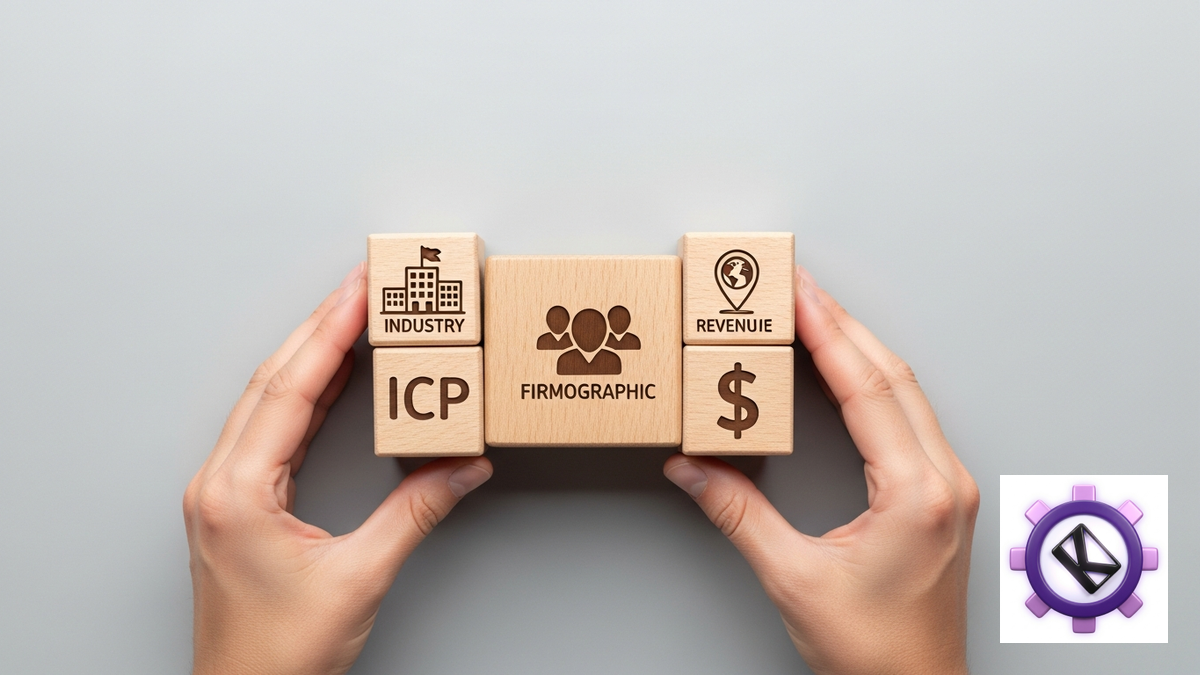
Firmographics: The Foundation of B2B Targeting
Company size, measured by employee count, serves as a foundational filter for B2B teams defining their Ideal Customer Profile (ICP). Analysis of successful go-to-market strategies reveals that teams frequently target specific headcount bands to ensure the prospect's operational complexity and budget align with the offered solution. For example, a marketing automation platform might define its core target as companies with 50-500 employees, a segment large enough to need sophisticated tooling but not so large as to have entrenched enterprise contracts. [27] This precision moves beyond vague labels like "SMB" or "enterprise." Data platforms like Apollo.io, which contains a database of over 73 million companies, allow teams to apply granular filters for headcount, enabling them to isolate niches such as mid-market tech companies with 200-1500 employees. [5] This segmentation is critical because company size often signals buying committee complexity, budget thresholds, and the potential for technology adoption. [18] As noted in a 2026 guide on building an ICP, a 10-person startup has vastly different needs and purchasing power than a 5,000-person corporation, making employee count an essential, quantitative starting point for all subsequent targeting and personalization efforts. [11]
Industry specialization is another critical firmographic attribute that high-performing B2B teams use to sharpen their focus and increase marketing resonance. Rather than adopting a horizontal approach, top teams concentrate their efforts on specific verticals where their solution addresses acute, industry-specific pain points. [23] For instance, a cybersecurity firm might exclusively target healthcare and financial services companies due to their stringent data security and compliance requirements. This vertical focus allows for highly tailored messaging and content marketing that speaks directly to the challenges and regulatory environment of that industry. [7] Data enrichment tools from vendors like Clearbit, now part of HubSpot, and ZoomInfo provide the deep firmographic data necessary for this segmentation, allowing teams to filter accounts by specific industry codes. [14, 15] This level of detail is crucial; analysis shows that a generic industry label like 'Technology' is insufficient, whereas a specific focus on 'B2B SaaS Companies' or 'Marketing Agencies' provides actionable clarity for sales and marketing execution. [16] By concentrating on a few key industries, businesses can build significant domain expertise, which in turn fosters trust and shortens sales cycles with knowledgeable buyers.
Annual revenue and geographic location are firmographic pillars used to qualify accounts and structure sales operations effectively. Revenue ranges, such as a target of $20M to $250M, act as a direct proxy for an organization's budget capacity and its ability to invest in new solutions. [13] This financial qualification prevents sales teams from wasting resources on companies that, despite being a good fit in other ways, cannot afford the product. According to a 2026 guide, segmenting by profitability is a powerful enabler for account-based marketing (ABM), as it concentrates resources on a handful of clients with confirmed budget potential. [6] Simultaneously, geographic location is essential for aligning sales territories, managing logistics, and tailoring localization efforts. [8] Many B2B teams focus on specific regions like North America or Western Europe to concentrate their market presence and comply with regional data laws like GDPR. [16] Data providers like Cognism are noted for their strong coverage in EMEA, while others like Apollo.io are popular for US-focused campaigns, demonstrating the strategic importance of geographic data in building an effective go-to-market plan. [3]
| Firmographic Attribute | Primary Use Case | Apollo.io | ZoomInfo | Clearbit (HubSpot) |
|---|---|---|---|---|
| Company Size (Employees) | Segmenting by operational complexity and budget thresholds. | Provides 65+ filters, including precise employee count bands. [5] | Offers deep firmographics with high fill rates on core fields. [5] | Enriches CRM records automatically with 100+ attributes, including headcount. [15] |
| Industry (Vertical) | Targeting sectors with specific pain points and regulatory needs. | Allows advanced filtering by industry and keywords for ICP targeting. [5] | Provides comprehensive global coverage across various industry codes. [5] | Specializes in real-time enrichment for accurate industry segmentation. [5, 14] |
| Annual Revenue | Qualifying accounts based on budget capacity and purchasing power. | Includes revenue estimates as a key filter for list building. | Offers detailed revenue data, often used for enterprise targeting. [27] | Provides revenue band data as part of its standard enrichment package. |
| Geographic Location | Aligning sales territories and localizing marketing campaigns. | Strong focus on US market data, with global capabilities. [3] | Leads in international data coverage, including non-HQ locations. [15, 5] | Enriches records with location data for geographic segmentation. |
| Technology Stack | Identifying integration opportunities and competitive displacements. | Includes technographics as part of its 65+ advanced filters. [5] | Offers detailed technographic data alongside firmographics and intent signals. [14] | A core strength, providing real-time technographic data for enrichment. [17] |
Technographics: How a Company's Tech Stack Signals Fit
A company's Customer Relationship Management (CRM) system is the most frequently tracked technographic attribute, serving as a foundational data point for defining an Ideal Customer Profile (ICP). Knowing whether a prospect uses a platform like Salesforce or HubSpot reveals critical information about their operational scale, sales processes, and potential for integration. For B2B teams, this signal is paramount; a 2024 survey by Freshworks of 600 business professionals found that 73% of businesses now use CRM software, with adoption in the tech sector reaching 94%. This high adoption rate makes CRM a reliable and widely available data point for segmentation. Teams use this information to tailor their outreach, for example, by pitching a Salesforce integration to a known Salesforce user, which immediately increases relevance and avoids the friction of proposing a solution incompatible with their core technology stack. According to research, 91% of companies with more than 10 employees use a CRM, making it a near-universal signal for identifying and qualifying accounts before investing significant sales resources.
The use of specific marketing automation platforms is a key technographic signal that indicates a prospect's marketing maturity and compatibility with new solutions. Companies that have invested in sophisticated platforms like Marketo or Pardot demonstrate a commitment to structured, data-driven marketing campaigns, signaling a higher level of operational maturity. This differs significantly from a company using a more basic email marketing tool, which may suggest a less developed marketing function and different integration needs. For vendors selling complementary marketing technologies, this distinction is crucial for effective targeting. Account-based marketing (ABM) strategies, for instance, heavily rely on identifying companies with a compatible and mature tech stack to ensure personalization can be executed at scale. Analyzing a prospect's marketing automation tools allows sales and marketing teams to infer their budget priorities, technical capabilities, and readiness to adopt adjacent technologies, making it a powerful qualifier in the ICP definition process. This intelligence enables teams to segment their market not just by industry or size, but by how they operate, which is a stronger predictor of fit.
A company's choice of cloud infrastructure and data analytics tools provides deep insights into its technical sophistication and cultural priorities, acting as strong signals for ICP alignment. The adoption of major cloud providers like Amazon Web Services (AWS), Microsoft Azure, or Google Cloud indicates a company's scale, technical expertise, and commitment to modern infrastructure. According to a Q4 2024 market analysis from CRN, these three providers alone account for approximately 68% of the global cloud market, with AWS holding 30%, Azure 21%, and Google Cloud 12%. A company heavily invested in AWS, for example, is a prime target for products that integrate seamlessly with the AWS ecosystem. Similarly, the presence of business intelligence (BI) tools like Tableau or Microsoft Power BI signals a data-driven culture. A 2025 report from ElectroIQ notes that 67% of the global workforce now has access to BI tools, highlighting a broad shift toward data-informed decision-making. For vendors selling data-related products or services, targeting companies that already use these BI platforms is a highly effective strategy, as it confirms the prospect values and actively invests in data analytics.
| Technographic Category | Key Vendors | Primary ICP Signal | Market Share/Adoption Stat | Data Source (Year) |
|---|---|---|---|---|
| CRM Platform | Salesforce, HubSpot | Sales process maturity, integration potential, operational scale. | 73% of businesses use a CRM. | Freshworks (2024) |
| Cloud Infrastructure | AWS, Microsoft Azure, Google Cloud | Technical sophistication, scalability, and infrastructure ecosystem. | AWS: 32%, Azure: 23%, Google: 10% | Hava.io (2024) |
| Business Intelligence (BI) | Tableau, Microsoft Power BI, Qlik | Data-driven culture, analytical maturity, need for data services. | Global BI market projected to be $54.27B by 2030. | ElectroIQ (2025) |
| Marketing Automation | Marketo, Pardot, ActiveCampaign | Marketing maturity, campaign sophistication, and martech stack density. | Considered a key tool for creating personalized interactions. | TEBillion (2024) |
| Sales Engagement | Outreach, Salesloft | Sophistication of sales outreach, focus on sales productivity. | Used to automate and personalize sales communication. | Cognism (2026) |
| Data Warehouse | Snowflake, Google BigQuery, Amazon Redshift | Advanced data management, capacity for large-scale analytics. | Signals high technical and data maturity. | Cognism (2026) |
From Attributes to Action: The GTM Data Stack
A well-defined Ideal Customer Profile becomes actionable through a go-to-market (GTM) data stack that begins with sales intelligence platforms. Tools like Apollo.io and ZoomInfo serve as the foundational layer, allowing revenue teams to source and enrich company data with critical firmographic and technographic attributes. [11, 27] These platforms provide more than just contact lists; they offer deep intelligence, including organizational charts, growth trends, and technology usage, which are essential for accurately matching companies against an ICP. [11, 22] For instance, a team might use Apollo.io to identify all SaaS companies with 50-200 employees using HubSpot, then enrich those accounts with verified contact information for marketing and sales roles. According to a 2026 analysis, ZoomInfo's data accuracy for emails reaches 80%, while Apollo.io achieves 73%, demonstrating the reliability teams depend on for high-volume outreach. [26] This initial step of sourcing and enrichment ensures that the top of the funnel is populated exclusively with accounts that fit the specific, data-defined parameters of the ICP, preventing wasted effort on poor-fit leads from the outset. [27]
Once accounts are sourced and enriched, the data is integrated directly into a Customer Relationship Management (CRM) platform like Salesforce to become the system of record for all GTM activities. [16] This integration is where data becomes intelligence, as it enables automated scoring and prioritization of accounts. According to a 2025 report, organizations that successfully integrate sales intelligence with their CRM see a 15-25% increase in sales productivity. [28] For example, a company can use Salesforce Einstein Lead Scoring, which leverages machine learning to analyze historical conversion data and identify which leads are most likely to convert. [23, 30] This AI-driven scoring moves beyond simple demographic criteria, incorporating thousands of data points to help sales teams focus their efforts. [29] A modern GTM stack architecture treats the CRM as the central authority for customer journey tracking, ensuring that as new data flows in from other tools, it is used to continuously refine account scores and dynamically route high-value prospects to the appropriate sales representatives for immediate follow-up. [2, 23]
To further refine prioritization, top B2B teams layer intent data into their CRM, identifying companies that are actively researching relevant solutions. Intent data providers, most notably through offerings like Bombora's Company Surge®, track content consumption across a vast cooperative of B2B publisher websites to detect when an account shows an abnormal spike in research around specific topics. [1, 18] For example, Bombora measures an account's research activity over a three-week period against a 12-week baseline; a score of 60 or higher indicates the account is "surging" with intent. [10] This data is often integrated via partners or directly into a CRM, allowing sales and marketing teams to see which of their target accounts are in an active buying cycle. [6] This capability transforms outreach from a static, scheduled process into a dynamic, signal-based motion, enabling teams to engage prospects with timely and highly relevant messaging precisely when they are most receptive. [1, 18]
The final step in the GTM data stack is activation, where the precisely defined and prioritized ICP is used to create custom audiences for targeted advertising and outreach campaigns. Data activation platforms like Clearbit are critical for this stage, enabling marketers to push their ICP segments to advertising platforms such as Facebook and Google. [8] Instead of relying on the ad platforms' often broad native targeting, teams can build hyper-targeted audiences using a combination of their own first-party CRM data and Clearbit's 100+ firmographic and technographic attributes. [7] For instance, a company could create a specific audience of B2B SaaS companies in the United States that use Salesforce and have between 50 and 1,000 employees. [8] This level of precision is highly effective; one case study showed that after replacing Facebook's native targeting with Clearbit-powered ICP audiences, paid ad programs generated $2 million in ARR in just 11 months, a 3,200% increase. [7] By activating a data-driven ICP, teams ensure their messaging reaches only good-fit leads, dramatically reducing wasted ad spend and maximizing revenue impact. [15]

Beyond Static Data: Using Behavioral and Intent Signals
A signal-based Ideal Customer Profile focuses on what a company is actively 'doing' rather than just what it 'is', fundamentally shifting targeting from static attributes to dynamic behaviors. Traditional ICPs relying solely on firmographics, such as company size or industry, are increasingly insufficient because they fail to capture buying readiness. A real sales ICP for 2026 integrates these foundational details with layers of technographics, intent signals, and crucial behavioral data. [A real sales ICP in 2026 looks more like a living model: firmographics layered with technographics, intent signals, behavioral data (https://scrap.io/ideal-customer-profile-sales/)]. This modern approach prioritizes buying triggers like recent funding rounds, executive leadership changes, or significant hiring surges for specific departments. The core distinction is between fit and intent; while firmographics determine if a company is a good structural fit, behavioral signals indicate whether it is a good fit right now. The most effective qualification systems combine ICP scoring, which evaluates fundamental fit, with behavioral scoring that tracks active intent, ensuring sales teams engage accounts that are not only suitable but also actively in-market.
Behavioral signals encompass a wide array of digital footprints that indicate active interest and purchase intent, moving far beyond simple demographic markers. These signals are captured from first-party sources, such as a company's own digital properties, and third-party data providers. Key first-party behavioral indicators include deep engagement with website content, like repeated visits to pricing pages, time spent on product demos, and content consumption patterns such as webinar attendance or whitepaper downloads. [How to Define Your ICP Using Intent Signals for Higher Sales (https://only-b2b.com/blog/how-to-define-your-icp-using-intent-signals-for-higher-sales/)]. These actions provide direct evidence of a prospect's research process. Third-party intent data, from platforms like Bombora which partners with sales intelligence tools, aggregates signals from across the web, identifying companies that are researching relevant keywords or consuming content about specific problems. An AI-driven ICP model analyzes these real-time signals, including website interactions and technographic data, to continuously refine who the best customers are, not just who they were assumed to be based on historical patterns.
Targeted outreach built on behavioral signals achieves conversion rates that significantly outperform traditional cold prospecting benchmarks. A 2026 study conducted by The Tolly Group evaluating the Apollo.io go-to-market platform provides a concrete example of this performance uplift. In the live test, which was not a simulation, Tolly executed a real outbound campaign for a new service, targeting 384 prospects across 205 companies. The methodology involved a three-email sequence with outreach capped at 50 emails per day to maintain deliverability. [Apollo Go-To-Market Solution Data Quality and Cold Email Outreach Evaluation (https://www.tolly.com/publications/detail/224101)]. For the first 169 contacts who completed this automated sequence, the campaign achieved a 2.37% conversion rate from cold outreach to a booked meeting. This result substantially exceeded the cited industry benchmark range of 0.5% to 1.5% for similar campaigns, demonstrating the power of combining a high-quality contact database with AI-assisted targeting based on business signals to improve relevance and drive conversions.
Refining an ICP is a continuous process that relies heavily on analyzing the patterns found within a company's most successful existing customers. Diving into historical data from Customer Relationship Management systems like Salesforce is critical for identifying the common threads among high-value accounts. This analysis should go beyond firmographics to include behavioral attributes, purchase history, product usage, and customer lifetime value. [Ideal Customer Profiles (ICPs): Benefits & How to Create (https://www.salesforce.com/blog/ideal-customer-profile/)]. By examining the interactions, sales cycle lengths, and product affinity of closed-won deals, teams can build a data-backed profile based on facts instead of assumptions. Feedback from customer-facing teams in sales and customer success provides qualitative context, revealing the specific pain points and motivations that analytics alone cannot. This feedback loop, where insights from current customers are used to sharpen the criteria for future prospects, ensures the ICP remains a relevant and effective tool for driving revenue.
Related reading
- see our anatomy of a buying signal analysis
- see our apollo vs zoominfo vs hunter vs snov analysis
- see our b2b buyer intent signal statistics analysis
- see our b2b contact data decay rate analysis
Frequently Asked Questions
What is the most common attribute used to define a B2B ICP?
The most common attributes used to define a B2B Ideal Customer Profile are firmographics, specifically company size and industry. [9, 20] These data points provide a foundational filter for segmentation because they are readily available and directly correlate with a company's needs and budget. [26] By analyzing their best existing customers, businesses can identify patterns in these attributes to focus their sales and marketing efforts on accounts that are most likely to convert and have a high lifetime value. [20]
How does firmographic data differ from technographic data in an ICP?
Firmographic data describes a company's core, stable attributes, while technographic data details its specific technology stack. [19] Firmographics include characteristics like industry, company size, revenue, and geographic location, which help determine if a company is part of your target market. [23] In contrast, technographics reveal the software and platforms a company uses, such as Salesforce for a CRM or AWS for cloud infrastructure, signaling technical maturity and potential integration opportunities. [13, 23] Effective B2B teams combine both; firmographics identify the right type of company, and technographics qualify them based on their existing tech environment. [19]
What tools do B2B teams use for ICP analysis?
B2B teams use a combination of internal and external data tools for ICP analysis, primarily CRM platforms and specialized B2B data providers. Internal analysis often starts with CRMs like Salesforce or HubSpot to identify traits of the most successful existing customers. [18] Teams then use external B2B data platforms like ZoomInfo, Apollo.io, or 6sense to enrich that data and find lookalike accounts in the broader market. [16, 30] For more advanced analysis, tools like Bombora provide intent data, while platforms like a B2B Customer Data Platform (CDP) unify data from all sources into a single view for deeper insights. [18, 28]
How often should a company update its Ideal Customer Profile?
A company should review and update its Ideal Customer Profile at least every six to twelve months, with some experts recommending a quarterly review. [11, 27] Markets are not static; customer needs, competitive landscapes, and your own product capabilities evolve, which can alter who your best customer is. [11] Fast-moving industries like technology and SaaS may require more frequent updates, such as quarterly or semi-annually, to maintain alignment and ensure marketing and sales teams are focused on the most profitable segments. [17] Regularly updating your ICP prevents wasted resources on outdated targeting and improves customer retention. [11, 24]
What is the difference between an ICP and a buyer persona?
An Ideal Customer Profile (ICP) defines the perfect company to target, while a buyer persona represents the people within that company who make purchasing decisions. [1, 6] The ICP is built on firmographic and technographic data like industry, company size, and technology stack to identify the right accounts. [5, 13] In contrast, a buyer persona is a semi-fictional profile detailing an individual's job title, responsibilities, pain points, and motivations. [2, 3] A successful strategy uses both: the ICP guides you to the right organizations, and buyer personas inform how you personalize messaging to engage the key decision-makers inside them. [8]
Last updated: July 2026